If you have ever wondered what is a corporate office, the short answer is this: a corporate office is the central workplace where a company’s leadership, strategy, and administrative functions live. It is the headquarters of a business, the place where the executive team sets direction and where company-wide decisions are made.
The term gets used loosely, and it overlaps with words like head office, headquarters, and branch. This guide defines a corporate office clearly, explains what actually happens inside one, and shows how it differs from a branch, satellite, or regional office, so you can use the right term with confidence in 2026.
Corporate office, defined
A corporate office is the primary location of a corporation where senior leadership, executive management, and core support functions are based. It is the operational and administrative hub from which company strategy, policy, and oversight flow to every other location the business runs.
Wezoo snapshot — US private offices for HQ & satellite locations
- 63+ private offices listed across major US metros
- Starting prices from about $419/month per office
- Median starting price around $2,235/month
- Top operators: WeWork, Regus, Spaces
What is a corporate office, exactly?
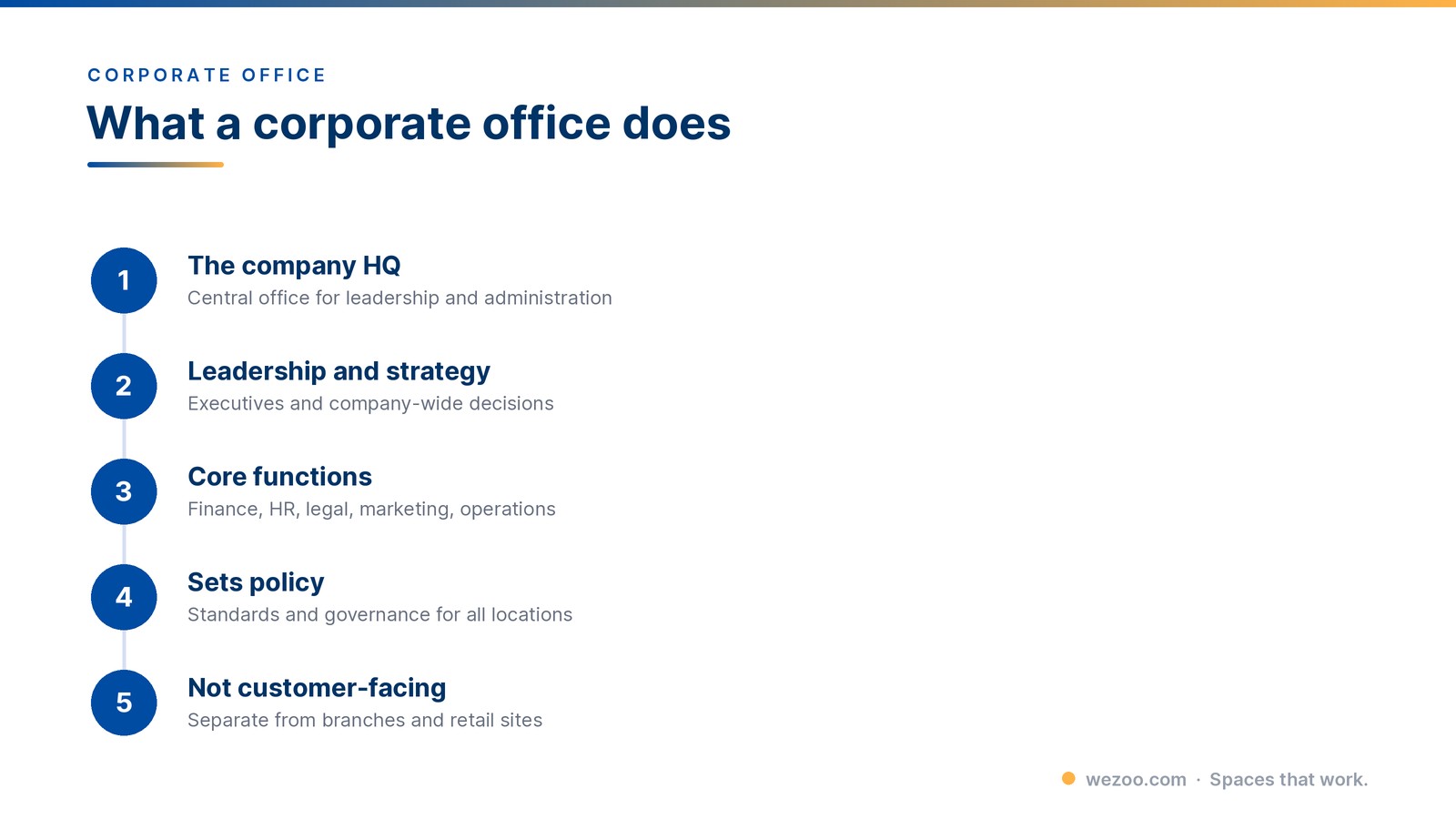
A corporate office is the headquarters of a company, the single address that represents the business at its highest level. It is where the chief executive, the leadership team, and the departments that steer the whole organization, such as finance, legal, human resources, and strategy, do their work.
So, what is a corporate office once you strip away the jargon? It is simply the headquarters that every other site reports to. From a retail store to a regional sales office, each location ultimately reports up to the corporate office. In practice, many corporate offices today are not sprawling owned campuses but leased, flexible spaces. A growing company can run its headquarters from a private office guide setup that scales with headcount rather than a long, rigid lease.
What does ‘corporate office’ mean in day-to-day business?
In everyday use, “corporate office” is shorthand for the part of a company that handles the business of running the business. When a customer is told to “call corporate,” they are being pointed at head-office decision-makers rather than a local branch.
People also ask what is a corporate office when they hear a company refer to “corporate.” It signals authority and centralization. Policies, brand standards, pricing frameworks, and major hiring decisions are typically owned at the corporate office and applied everywhere else. That is the practical meaning behind the word: it is the center of gravity for a company’s direction.
Corporate office vs head office: are they the same thing?
For most companies, yes. “Corporate office,” “head office,” and “corporate headquarters” are used interchangeably to describe the main site where leadership sits and top-level decisions are made.
Any nuance is subtle. “Head office” leans slightly toward the executive and decision-making role, while “corporate office” can also cover the wider cluster of corporate support staff based at that location. A registered office is different again: that is the official legal address of a company on public record, which may or may not be where anyone actually works.
How is a corporate office different from a branch or satellite office?
The clearest way to understand a corporate office is to compare it with the other office types that report into it. A branch office serves a local market with its own staff and, often, its own profit-and-loss responsibility. A satellite office is a smaller, remote outpost that depends on the headquarters for direction and back-office support.
| Office type | Primary role | Autonomy | Reports to |
|---|---|---|---|
| Corporate office (HQ) | Sets company-wide strategy & policy | Highest | Board / shareholders |
| Regional office | Oversees a territory or group of branches | Medium–high | Corporate office |
| Branch office | Serves a local market with full functions | Medium | Corporate / regional office |
| Satellite office | Small remote team or single function | Low | Corporate office (HQ) |
If you are weighing up these smaller sites, it helps to know exactly what is a satellite office and how it fits alongside a headquarters. For the finer distinction between the two remote formats, our guide on satellite office vs branch office breaks down when each one makes sense.
What functions sit at a corporate office?
Another way to answer what is a corporate office is to look at who works there. A corporate office concentrates the functions that govern the entire company rather than serve a single market. Typical departments based there include:
- Executive leadership — the CEO, C-suite, and their direct reports.
- Finance and accounting — consolidated reporting, treasury, and budgeting.
- Legal and compliance — contracts, governance, and risk.
- Human resources — company-wide policy, benefits, and senior hiring.
- Strategy, marketing, and corporate communications — brand and direction owned centrally.
These teams need boardrooms, quiet focus space, and room to grow. That is why the shape of the corporate office matters as much as its address.
How do modern companies run HQ and satellite offices?
Knowing what is a corporate office is one thing; deciding what it should look like is another. The idea that a corporate office must be an owned tower is out of date. Many companies now run a lean headquarters plus a handful of satellite offices, and they use flexible private offices for both. A private office gives a team a lockable, branded, fully serviced space without a decade-long lease.
That model lets a business open a corporate office in a new city in weeks, add desks as it hires, and keep its satellite locations consistent with the headquarters. Wezoo lists 63+ private offices across US metros, with starting prices from about $419/month, so you can set up an HQ or a satellite site with the same simple inquiry.
Ready to set up a corporate office that scales with you?
Frequently asked questions
What is a corporate office in simple terms?
A corporate office is a company’s main office, where its leaders, executives, and central support teams work. It is the place where company-wide decisions are made and from which every other location takes direction.
Is a corporate office the same as a headquarters?
Yes. “Corporate office,” “head office,” and “corporate headquarters” all describe the same thing: the central site where a company’s leadership is based and top-level strategy is set.
What is the difference between a corporate office and a branch?
A corporate office sets company-wide strategy and policy and sits at the top of the structure. A branch office serves a specific local market, runs its own day-to-day operations, and reports up to the corporate office.
Does ‘corporate office’ mean the same as ‘registered office’?
No. A corporate office is where leadership actually works. A registered office is the official legal address of a company on public record, which can be different and may have no staff on site.
What departments are usually in a corporate office?
Executive leadership, finance, legal and compliance, human resources, and strategy or corporate communications are the functions most often based at a corporate office, because they govern the whole company.
Can a startup have a corporate office?
Yes. A corporate office simply means the company’s central base. Many startups run their headquarters from a flexible private office they can lease month to month and expand as the team grows.