If you are weighing satellite office vs branch office, the two terms describe different ways to grow beyond your headquarters — and picking the wrong one can lock you into more space, cost and management than you need. Both are secondary locations, but they differ in size, autonomy, function and staffing. This guide defines each, sets them side by side, and shows how a flexible private office guide fits either model.
Get the distinction right and your expansion moves fast. Get it wrong and you carry overhead a smaller footprint would have avoided. Here is the clear version of satellite office vs branch office, built for teams planning their next US location.
What is a satellite office?
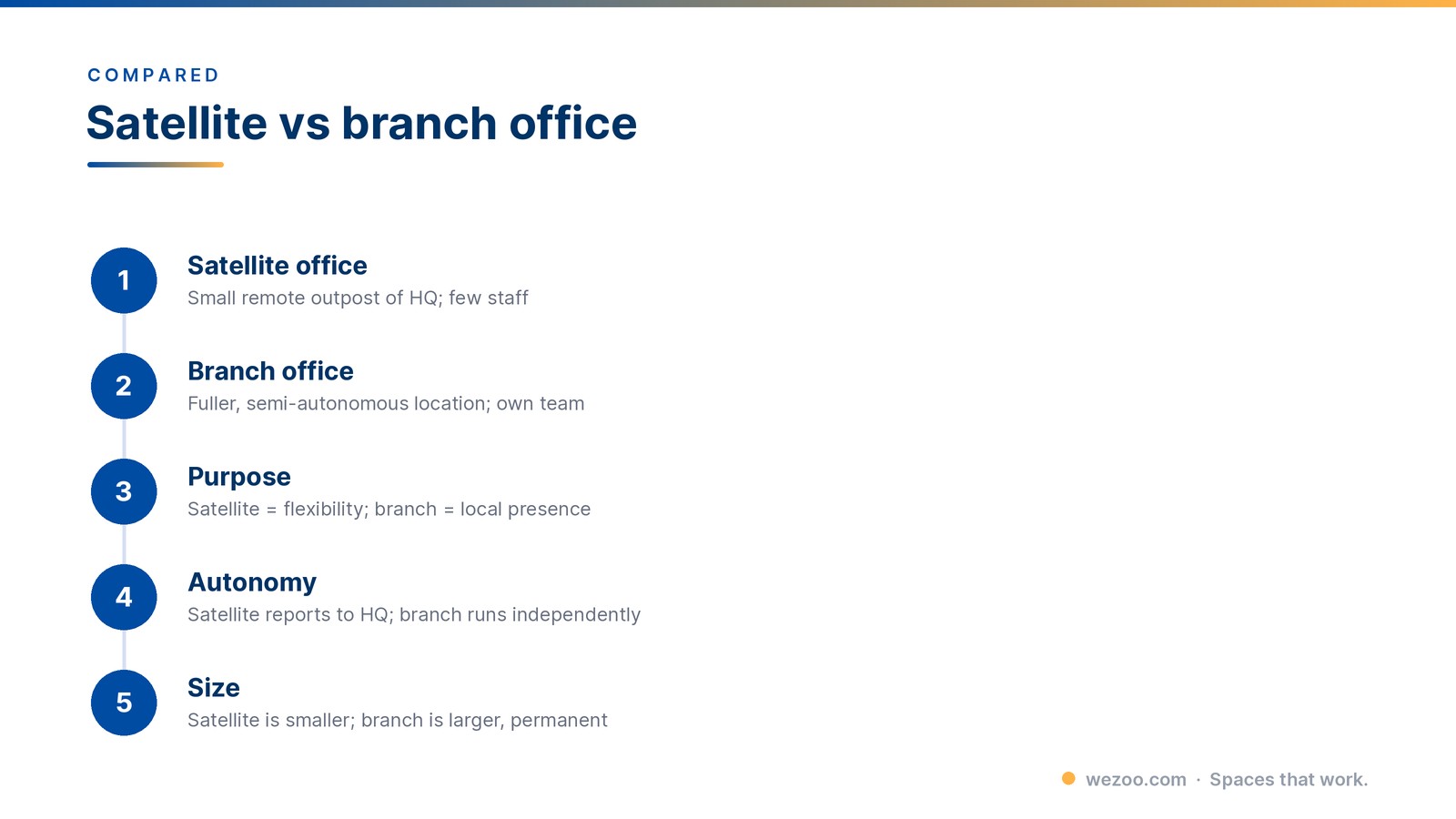
A satellite office is a small, secondary workspace that stays connected to headquarters for nearly everything: strategy, budgets, hiring policy and admin. Think of it as orbiting the mothership. It exists to put a specific team — sales, engineering, support — closer to the talent, clients or market that team needs, without recreating the whole company. If you want the full picture, our companion post explains what a satellite office is in depth.
What is a branch office?
A branch office is a larger location that operates like a compact version of the entire business. It usually has its own leadership, handles a broad set of functions, and often carries its own profit-and-loss responsibility. A bank branch or a regional sales-and-service hub is the classic example: customers can get most of what headquarters offers, delivered locally. the reference definition of a branch office underscores that autonomy and local accountability.
Satellite Office vs Branch Office: The Core Difference
The heart of the satellite office vs branch office question is autonomy and scope. A satellite office is narrow and dependent; a branch office is broad and semi-independent. This table lines up the differences that matter when you plan a second location.
| Feature | Satellite office | Branch office |
|---|---|---|
| Size | Small — a handful of desks to a single team | Larger — multiple teams and departments |
| Autonomy | Leans on HQ for strategy, budget and admin | Runs semi-independently, often with its own leadership |
| Function | Narrow — one team, market or client base | Broad — a smaller mirror of the whole company |
| Financials | Costs roll up to headquarters | Often carries its own profit-and-loss responsibility |
| Staffing | A single function — sales, engineering or support | A cross-section of functions under a branch manager |
| Best when | You want a foothold close to talent or clients | You need a full local presence that can operate on its own |
Wezoo snapshot — US private offices
- 63 private offices listed in New York, Wezoo’s deepest US market, with more in every major metro
- Price range: from $419 to $52,374 per month (single rooms to full-floor suites)
- Median: about $2,235 per month
- Top operators: WeWork, Regus, Spaces
When should you choose a satellite office over a branch office?
Choose a satellite office when you want a foothold, not a full outpost. It is the right call for a sales pod near a key account, an engineering team close to a talent pool, or a client-facing base in a new city. Choose a branch office when the location must stand on its own — serving customers end to end, making local decisions, and owning its own numbers. Many distributed companies run both at once, a pattern known as the hub-and-spoke office model: a headquarters hub feeding smaller satellites and branches.
Staffing usually decides it. A satellite office holds one function under a team lead. A branch office holds a cross-section of the company under a branch manager. Match the office type to the org chart you actually need on the ground.
How flexible private offices support either model
Whether you land on a satellite or a branch office, the space itself does not have to mean a five-year lease and a build-out. A flexible private office gives you a lockable, furnished, move-in-ready room in a managed building — two desks for a satellite team, or a larger suite for a branch. You request the size you need now and adjust as the location grows. Book the room; keep the flexibility.
What does a private office for a satellite or branch location cost?
On Wezoo, US private offices start from about $419 per month for a compact room and run into five figures for full-floor branch suites, with a median near $2,235 per month. Pricing tracks city, building and headcount — our guide to how much a private office costs breaks down the drivers. Capacity and availability are listed per space, so you can size a satellite or a branch before you ever tour it.
Ready to open your satellite or branch office?
Frequently asked questions
What is the difference between a satellite office and a branch office?
A satellite office is a small workspace that serves one narrow purpose and depends on headquarters for strategy, budgets and admin. A branch office is a larger, more self-contained location that runs like a small version of the whole company, often with its own leadership and profit-and-loss responsibility.
Is a satellite office the same as a branch office?
Sometimes the terms are used interchangeably to mean any location that is not headquarters. The useful distinction is autonomy and scope: satellite offices stay tied to HQ and cover one function, while branch offices operate semi-independently across several functions.
What does satellite office mean?
Satellite office meaning: a compact, secondary workspace that orbits a company’s headquarters. It gives a team a dedicated base closer to employees, clients or a new market without duplicating the full organization.
What does branch office mean?
Branch office meaning: a company location separate from headquarters that carries out the full range of a business’s activities on a local scale, usually with a branch manager and local accountability.
When should a company choose a branch office over a satellite office?
Choose a branch office when the new location needs to make independent decisions, serve customers end to end, and own its own numbers. Choose a satellite office when the goal is a focused presence — a sales pod, an engineering hub or a client-facing base — that still reports into HQ.
Can a private office work for both models?
Yes. A flexible private office scales from a two-desk satellite to a larger branch suite, so you can request the size you need now and adjust as the location grows — without signing a long conventional lease.
The short version of satellite office vs branch office: a satellite office is a focused, HQ-dependent foothold; a branch office is a broader, semi-independent location that can run on its own. Decide by autonomy and staffing, then let a flexible private office give you room to start small and grow. Space should never be the thing that slows your expansion.