If you are weighing subletting vs subleasing for office space, the short answer is that the two words usually describe the same thing — a tenant re-renting their space while staying on the original lease. The distinction that matters for your money and your risk is not the label but who stays liable to the landlord, and that is what this 2026 guide makes clear.
Below you will find plain-English definitions, a side-by-side comparison, how each plays out for a real office, the pros and cons, and when a flexible private office is simply the easier move. Along the way we point back to our private office guide for the low-commitment alternative.
What do subletting and subleasing actually mean?
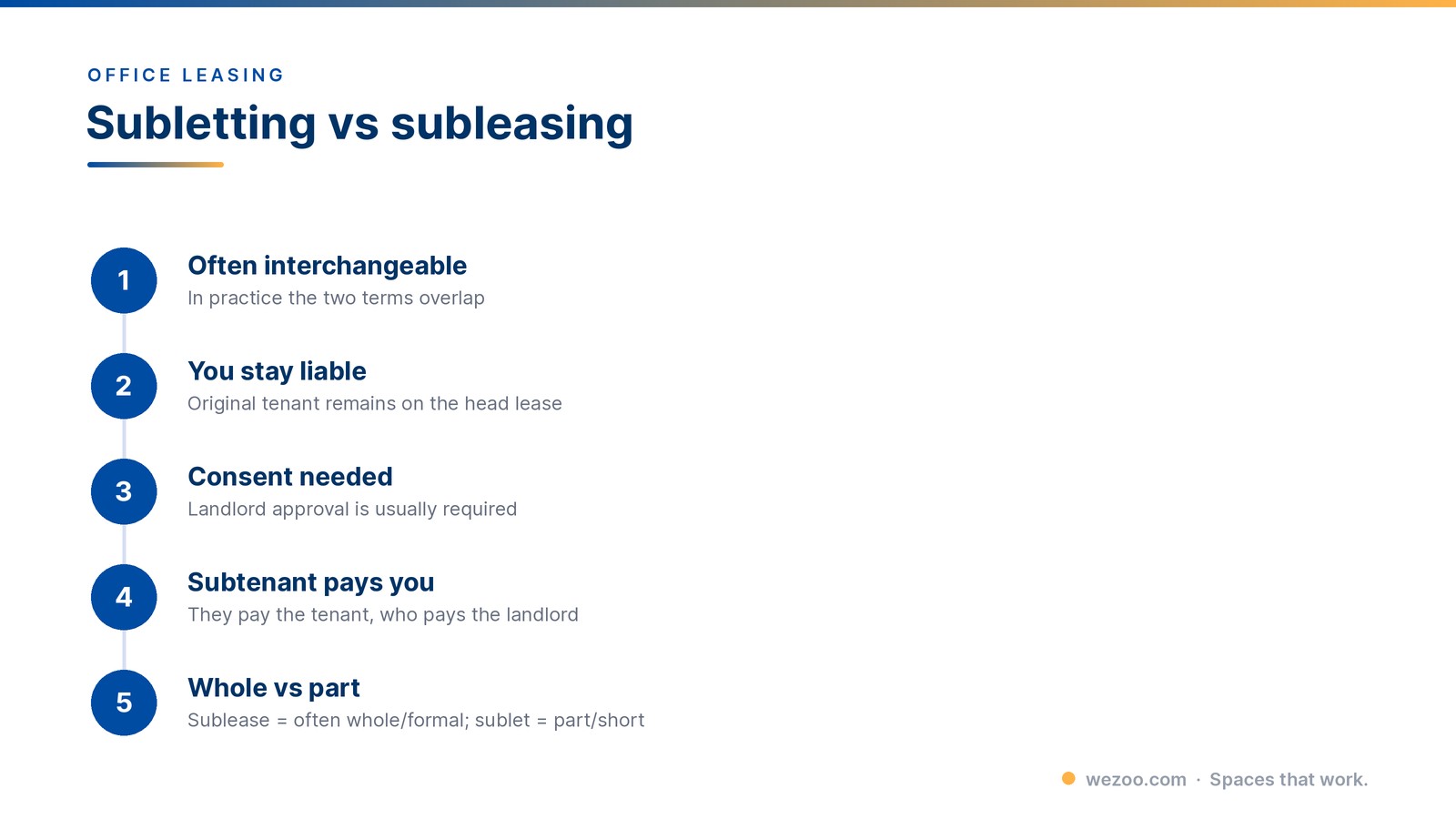
Subletting (or subleasing) is when you, the tenant, rent your leased space to another business — the subtenant — while your name stays on the head lease with the landlord. The subtenant pays you, and you keep paying the landlord. You are the middle link in the chain, not out of it.
In practice the terms are interchangeable. Some markets use “sublet” for a portion of space or an informal setup and “sublease” for a formal document covering the whole premises, but the legal effect is the same. The sharper line to understand is sublease versus assignment — the legal definition of a sublease from Cornell Law School is a useful reference — and it is covered below.
Wezoo snapshot — US private offices
- 60+ private offices listed in a single US market on Wezoo
- Starting price: from $419/month
- Median starting price: about $2,330/month
- Top operators: WeWork, Regus, Spaces
Subletting vs subleasing: the 7 key differences
Here is how the two terms line up on the factors people actually search for. Notice that the meaningful rows are about liability and consent, not the words themselves.
| Factor | Subletting | Subleasing |
|---|---|---|
| Common meaning | Renting out part or all of your space to a subtenant | Often used interchangeably with subletting for the same arrangement |
| Portion of space | Frequently a portion (a few desks, a floor) | Frequently the entire premises, but can be partial |
| Who stays on the head lease | You do — you remain the tenant | You do — your name stays on the original lease |
| Who is liable to the landlord | You are, if the subtenant defaults | You are, unless the landlord formally releases you |
| Rent flow | Subtenant pays you; you pay the landlord | Subtenant pays you; you keep paying the landlord |
| Landlord consent | Almost always required | Almost always required |
| The real fork | Both keep you liable | An assignment (not a sublease) is what can transfer liability |
For a fuller picture of how these arrangements sit next to standard leases, see our comparison of serviced, managed and leased offices.
Landlord consent and profit-sharing
One row deserves extra weight: consent. Most commercial leases require written landlord approval before you sublet, and many go further — reserving the right to approve the subtenant, cap the term, or take a share of any rent you collect above your own. Skipping this step can put you in default on the head lease, which is a far bigger problem than an empty desk. Read your assignment-and-subletting clause before you market a single square foot.
Who holds the lease and who is liable?
You do, on both counts. In a sublet or a sublease, you remain the tenant of record and you remain liable to the landlord. If the subtenant misses rent or damages the space, the landlord comes to you, not to them.
The only clean way to hand off that liability is an assignment, where you transfer the entire lease to a new tenant — and even then, only if the landlord agrees and formally releases you. A sublease is a bridge over a gap in your space needs. An assignment is the door out. Confusing the two is the most expensive mistake in this whole topic.
How does subletting vs subleasing work for office space?
The subletting vs subleasing question gets most practical here. Picture a team that signed for 8,000 square feet and now uses 5,000. Rather than eat the rent on empty desks, they sublet the spare floor to a smaller company. The subtenant signs a sublease with the team, pays them monthly, and follows the rules of the original lease. The head-lease clock keeps ticking, and when it ends, the sublease ends with it.
That timing is the catch for office space. A sublease can never outlast the lease it sits under, so a subtenant often inherits a short, fixed runway plus someone else’s fit-out and furniture. If you need a private, lockable office without that baggage, our roundup of flexible private offices you can book shows the alternative.
Pros and cons of subletting your office
Subletting can be smart when you have genuine surplus space and want to offset rent instead of breaking a lease. It keeps the space occupied, protects your relationship with the landlord, and can recover real money each month. Investopedia’s overview of how a sublease works is a solid primer on the mechanics.
The costs are less visible. You take on landlord-style duties — marketing the space, vetting the subtenant, drafting the sublease, and collecting rent — while staying liable if the subtenant walks away. For a subtenant, the trade is a short, fixed term, limited control over changes to the space, and dependence on a lease you do not hold. If the head tenant defaults upstream, the subtenant can lose the space through no fault of their own.
When is a private office simpler than a sublease?
A flexible private office skips the whole liability chain. You do not inherit anyone’s lease, remaining term, or fit-out. You request a move-in-ready office by the month, see the capacity and a starting price up front, and scale up or down as your team changes.
On Wezoo, US private offices start from around $419/month, with a median starting price near $2,330/month — no subtenant to vet and no head lease to worry about. When the sublease math gets complicated, the ready-made office is often the calmer choice.
Prefer a move-in-ready office to a second-hand sublease?
Subletting vs subleasing: frequently asked questions
Is subletting the same as subleasing?
In everyday commercial real estate they are used interchangeably: a tenant re-rents space to a subtenant while staying on the head lease. Some regions lean on “sublet” for a room or portion and “sublease” for a formal document covering the whole space, but the legal effect is the same. The distinction that actually changes your liability is sublease versus assignment.
What is the difference between subletting and subleasing for office space?
For office space, both mean you rent your leased premises to another business while you remain the tenant of record. You collect rent from the subtenant and keep paying your landlord. If the subtenant stops paying or damages the space, the landlord looks to you.
Who is liable in a sublease?
The original tenant. Unless your landlord signs a release, you stay responsible for rent and lease obligations even after a subtenant moves in. That is why a sublease is a bridge, not an exit — an assignment is the route that can transfer liability, and only with landlord consent.
Do I need my landlord’s permission to sublet or sublease?
Almost always yes. Most commercial leases require written landlord consent before you sublet or sublease, and many spell out conditions such as approving the subtenant or sharing any profit. Subletting without consent can put you in default, so read your clause first.
Is subletting office space a good idea?
It can be, when you have space you no longer need and want to offset rent rather than break the lease. The trade-offs are the admin of finding and vetting a subtenant, ongoing liability, and terms that end when your head lease ends. For many teams a ready-to-use private office is the simpler route.
What is a simpler alternative to taking over an office sublease?
A flexible private office. Instead of inheriting someone else’s lease, remaining liabilities, and fit-out, you request a move-in-ready private office by the month, with capacity and a starting price shown up front. It is the low-commitment way to get a private, lockable office without the sublease paperwork.
The bottom line on subletting vs subleasing
Strip away the jargon and subletting vs subleasing comes down to one move: renting your space to a subtenant while you stay on the lease and stay liable. If you want out entirely, you are looking at an assignment, not a sublease — and only with your landlord’s blessing. And if the whole exercise feels heavier than the space is worth, a flexible private office gives you the room without the paperwork.