A modified gross lease sits in the middle of the two most common commercial office lease structures: the full-service gross lease and the triple net lease. In a modified gross lease, you and the landlord split the property’s operating costs instead of one side carrying all of them, which is why it shows up so often in multi-tenant office buildings.
If you are comparing office space in the United States in 2026, the lease type shapes your real monthly cost as much as the rent number itself. This tenant-side guide explains what a modified gross lease covers, which expenses typically fall to the landlord versus the tenant, how it compares to gross and triple net, and the clauses worth checking before you sign. For the full picture of leasing a dedicated room, see our private office guide.
Disclaimer: This is general information, not legal or financial advice — consult a qualified attorney, CPA or commercial real-estate advisor before signing any lease. Terminology and cost-sharing vary by market and by contract.
What is a modified gross lease?
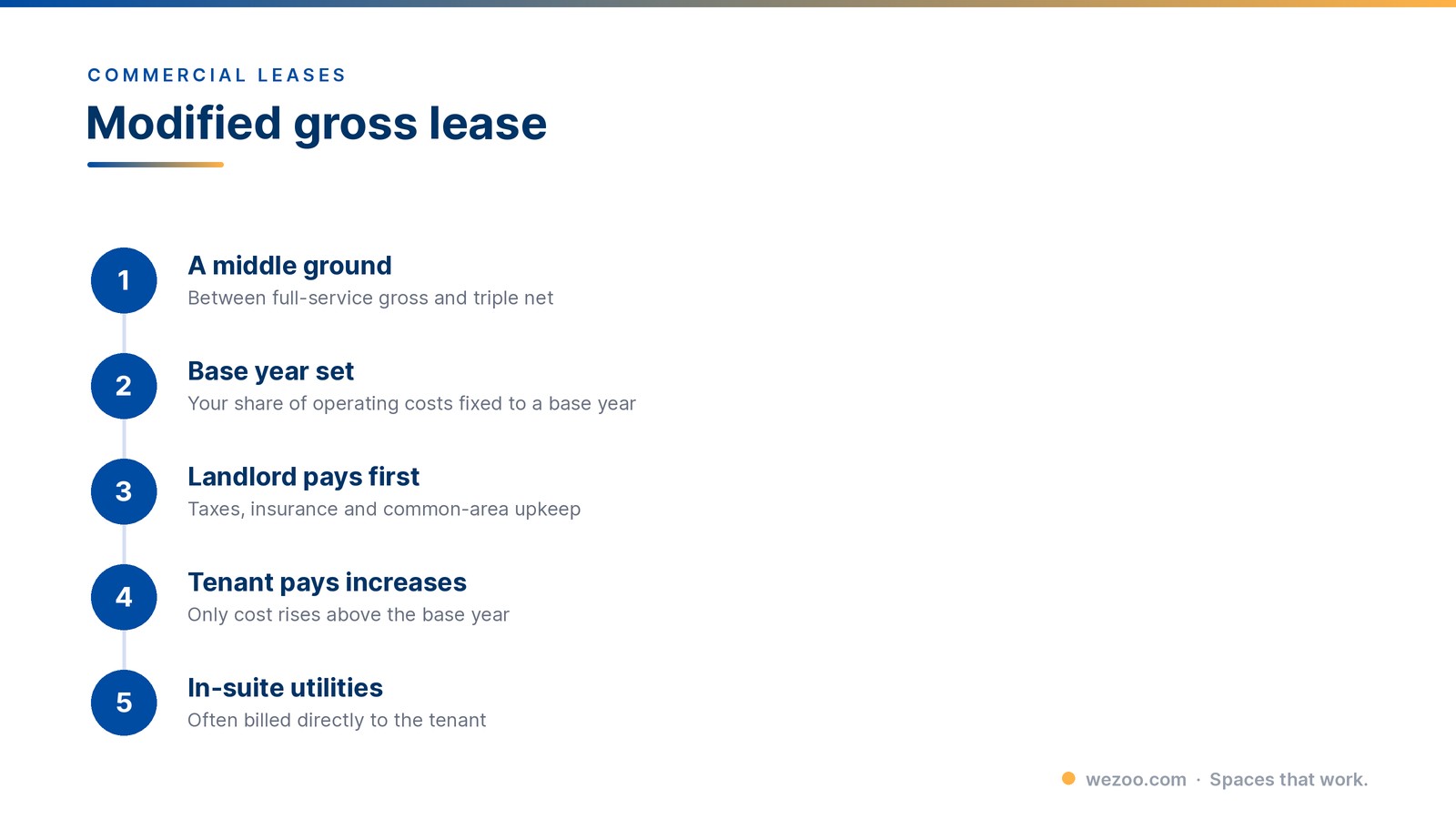
Modified gross lease (MGL): a commercial lease in which the tenant pays base rent plus an agreed share of operating expenses, while the landlord covers the rest. It blends the single-payment simplicity of a full-service gross lease with the cost pass-throughs of a triple net lease, and the exact split is negotiated line by line.
There is no fixed formula. A modified gross lease is defined by what the two parties agree to share, so two buildings on the same street can quote “modified gross” and mean different things. That flexibility is the point — and the reason the expense schedule deserves a close read. Investopedia’s overview of the modified gross lease and Cornell Law School’s Legal Information Institute entry on a lease are useful primary references while you compare offers.
Who pays what in a modified gross lease?
In a typical modified gross lease the tenant takes on the costs tied to its own suite, while the landlord keeps the building-wide obligations. The common split looks like this, though every line is negotiable:
- Usually the tenant: in-suite utilities (electricity, sometimes gas), interior janitorial and cleaning, and day-to-day maintenance inside the leased space.
- Usually the landlord: property taxes, building insurance, structural repairs, and common area maintenance (CAM) for lobbies, elevators and shared restrooms.
- Often shared or capped: increases in taxes, insurance and CAM above a base year or expense stop — the tenant pays its pro-rata share of the growth, not the whole bill.
That base-year mechanism is the detail tenants miss most. The landlord absorbs operating costs up to the first year’s level; you pick up your share of anything above it in later years. Confirm the base year, your pro-rata percentage, and whether any category is excluded.
Modified gross vs full service vs triple net
The three structures differ in one thing: where the operating-cost risk lands. A full-service (gross) lease puts it on the landlord, a triple net lease puts it on the tenant, and a modified gross lease divides it. Our companion explainer on the triple net lease goes deeper on the NNN end of the spectrum.
| Feature | Full-service gross | Modified gross | Triple net (NNN) |
|---|---|---|---|
| Who pays operating costs | Landlord (built into rent) | Split — negotiated | Tenant (rent + taxes, insurance, CAM) |
| Quoted rent | Highest, all-in | Middle | Lowest base, plus pass-throughs |
| Cost predictability | Very high | Moderate | Lower — varies with actual costs |
| Common use | Smaller offices, coworking suites | Multi-tenant office buildings | Standalone / retail / industrial |
| Tenant admin effort | Low | Medium | High |
Rent numbers are not comparable across structures until you load in the extras. A triple net rate of $30 per square foot can land near a $42 full-service quote once taxes, insurance and CAM under a triple net lease are added. The modified gross lease usually lands between the two.
Wezoo snapshot — US private offices
- Private offices listed across major US markets, many in multi-tenant buildings that use modified gross or full-service terms
- New York City example: 63 private-office locations currently listed
- Monthly “from” price range in that market: about $419 to $52,000+, depending on size and building
- Median monthly “from” price: around $2,235
- Top operators: WeWork, Regus, Spaces
Figures illustrate one large market and are indicative only; actual terms are set per building and per contract.
A simple modified gross lease example
Picture a 2,000-square-foot suite quoted at $28 per square foot on modified gross terms. The tenant pays $56,000 a year in base rent and covers its own electricity and interior cleaning — say $6,000 a year. The landlord keeps property taxes, insurance and CAM inside the quoted rent, using the first lease year as the base year. If building taxes and CAM rise the next year, the tenant pays only its pro-rata share of the increase, not the full jump. That shared-risk shape is the signature of a modified gross lease.
What should an office tenant check before signing?
The label “modified gross” tells you the risk is split; the lease tells you how. Before you sign, confirm these points in writing:
- The expense schedule: exactly which costs are yours, which are the landlord’s, and which are shared.
- Base year and expense stop: the baseline for pass-through increases and how your share is calculated.
- Pro-rata percentage: your suite’s square footage as a share of the building’s leasable area.
- Caps and exclusions: annual limits on controllable expense growth, and any capital or structural items you should never be charged for.
- Audit rights: the ability to review the landlord’s operating-expense statements.
Read the meaning, not just the heading. Two modified gross leases can share a name and split costs very differently.
Ready to compare private offices without the long-lease guesswork?
When does a modified gross lease make sense?
A modified gross lease fits tenants who want more budget certainty than a triple net lease offers, but who are comfortable managing their own utilities and cleaning to keep the quoted rent down. It is a natural fit in shared office buildings, where one landlord runs the common systems and each tenant handles its own suite. Growing teams often prefer it because the base-rent number is predictable and the shared-cost exposure is capped by the base year. If your priority is zero admin and one flat invoice, a full-service gross lease or a flexible private office may suit you better; if you want the lowest headline rent and can absorb variable costs, triple net may win. The middle path earns its keep when neither extreme fits.
Modified gross lease FAQ
What is a modified gross lease in simple terms?
A modified gross lease is a commercial lease where the tenant pays base rent plus an agreed share of operating expenses, and the landlord pays the rest. It is a negotiated middle ground between a full-service gross lease and a triple net lease.
What is the difference between modified gross and full service?
In a full-service gross lease the landlord builds every operating cost into one rent figure. In a modified gross lease, some costs — often utilities and in-suite cleaning — are carved out and paid by the tenant, so the quoted rent is usually lower but less all-inclusive.
What is the difference between modified gross and triple net?
A triple net lease passes property taxes, insurance and common area maintenance through to the tenant on top of base rent. A modified gross lease splits those costs, with the landlord typically keeping taxes, insurance and structural items while the tenant covers its own utilities and interior upkeep.
What does a tenant usually pay in a modified gross lease?
Most often the tenant pays base rent, its own in-suite utilities, interior janitorial, and its pro-rata share of operating-cost increases above the base year. The exact list is set in the lease’s expense schedule.
Is a modified gross lease good for tenants?
It can be, because it offers more cost predictability than a triple net lease while usually costing less than a full-service quote. Whether it is right for you depends on the specific expense split, caps and base year — confirm those with a qualified advisor.
Are modified gross leases common for office space?
Yes. Modified gross leases are especially common in multi-tenant office buildings, where sharing operating costs is simpler than either extreme. For shorter commitments, a private office can be a flexible alternative to a multi-year lease.
The lease type is not fine print — it is the price. A modified gross lease can be the fair middle path for an office tenant, as long as you know which costs are yours and how increases are shared. Read the expense schedule, check the base year, and bring in an advisor before you sign.